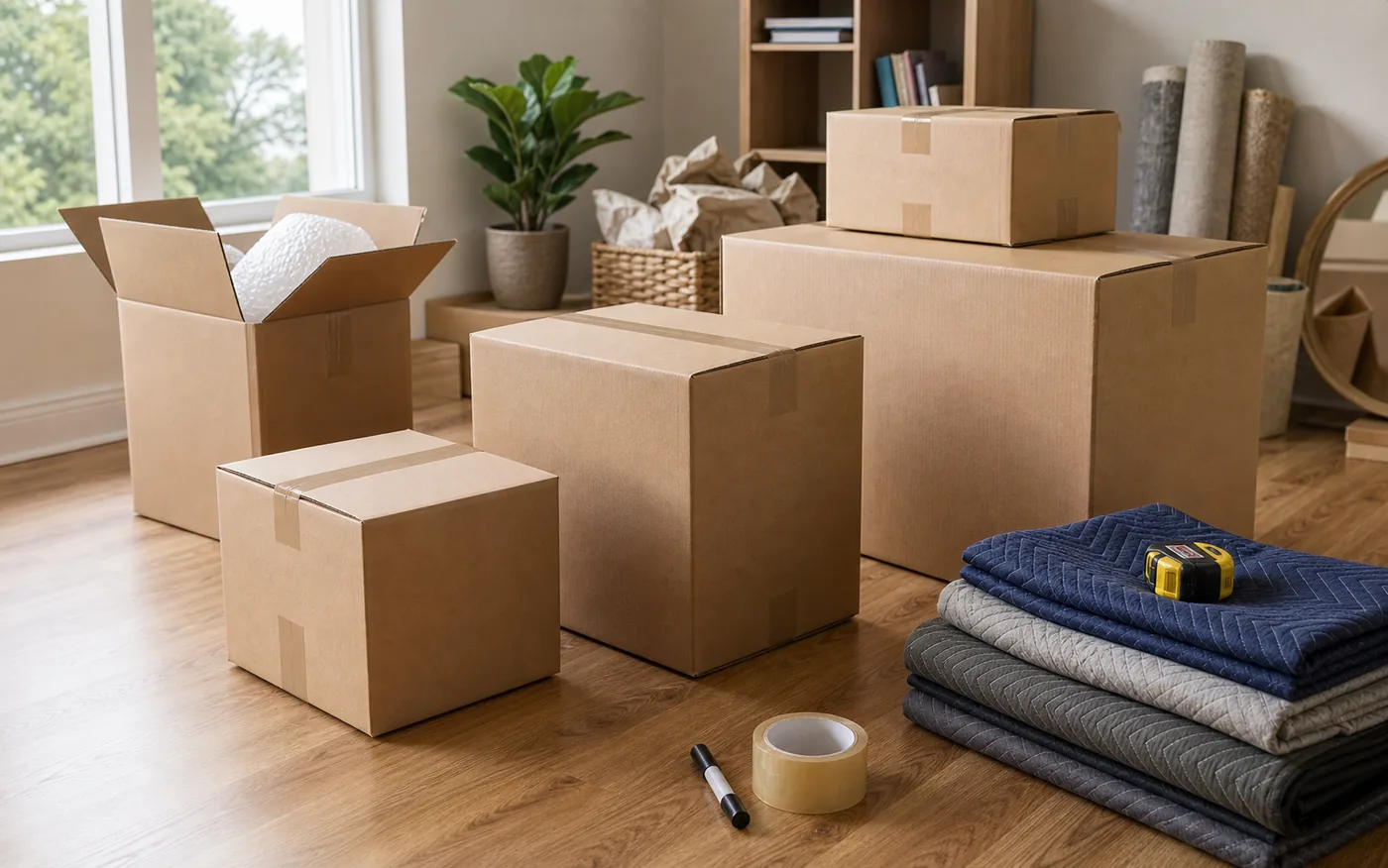
Worksheet
Room inventory worksheet
- List rooms and storage areas.
- Mark heavy items that need smaller boxes, such as books.
- Mark fragile items that need padding and extra space.
- Estimate wardrobe or specialty boxes only where useful.
- Add a small buffer for last-minute items.
Checklist
Heavy-and-fragile item checks
- Using bedroom count alone.
- Putting books into oversized boxes.
- Forgetting kitchen items and fragile packing material.
- Not keeping essentials separate for the first night.
Worked scenario
Two-bedroom packing scenario
A one-bedroom apartment with many books may need more small boxes than a larger space with fewer dense items.
Box size mix
Small boxes are useful for heavy items, medium boxes fit many general belongings, and large boxes are better for light bulky items.
Packing supplies
Tape, labels, markers, padding, and protective wrap can be just as important as box count for a smooth move.
Measured data and planning inputs
Published U-Haul moving-box dimensions
Box labels such as small or medium are not universal. These U-Haul dimensions provide a concrete first-party example and show why a useful box estimate should retain the supplier and dimensions rather than only a size name.
| U-Haul size | Published dimensions | Approximate exterior volume | Evidence |
|---|---|---|---|
| Extra small | 12 x 12 x 12 in | 1.00 cu ft | Primary source U-Haul box buying guide Accessed July 2026 |
| Medium | 18 1/8 x 18 x 16 in | about 3.02 cu ft | Primary source U-Haul box buying guide Accessed July 2026 |
| Extra large | 24 x 18 x 24 in | 6.00 cu ft | Primary source U-Haul box buying guide Accessed July 2026 |
Approximate volume is calculated from the published exterior dimensions; usable interior volume is smaller and packing efficiency varies.
Check the current supplier page for weight guidance and specialty boxes before substituting one large box for several smaller ones.
Visual measurement worksheet
Moving box mix organized by item density
Three box silhouettes compare small dense-item boxes, medium general-purpose boxes, and large light-item boxes, with arrows to books, kitchenware, and bedding groups.
Contrasting conditions
A harder case: a book-heavy one-bedroom move
A one-bedroom apartment has typical clothing and kitchenware but also 18 linear feet of books and six framed prints. Instead of accepting a room-count total unchanged, the estimate shifts capacity toward smaller boxes and adds protected picture containers.
- Start with the calculator's editable one-bedroom planning mix and record it as the baseline, not a promise.
- Count the 18 ft of shelving as a dense-item exception; move part of the medium-box allowance into smaller boxes that are easier to carry within supplier weight guidance.
- Keep six framed prints out of the general large-box count and price suitable picture or mirror boxes plus padding.
- Add a separate essentials box and two last-day buffer boxes so those items are not hidden in the room baseline.
Result: The revised plan may use more individual boxes than the room-count baseline while using similar total volume. That is a valid outcome because carry weight, fragility, and unpacking order are part of a workable supply mix.
Review: This case is difficult because volume alone points toward fewer large boxes, while safe handling points toward more small containers. The final list should show the supplier dimensions and intended item group for each box category.
Using the box data with a room inventory
Treat room count as a starting index, then inspect the storage hidden inside each room. Built-in cabinets, under-bed containers, hobby supplies, garage shelves, and seasonal items can dominate the final count. Categorize dense, fragile, bulky-light, hanging, and irregular items before adjusting the size mix. A cubic-foot comparison is useful for understanding box scale, but exterior volume overstates usable space and says nothing about how tightly objects nest or how much cushioning they require.
Keep supply planning connected to the move process. Boxes needed for last-day kitchen and bathroom items should remain accessible, while books and rarely used items can be packed early. Labeling, tape, wrap, dividers, and mattress or picture protection should be listed separately from box count. HomeMeasureKit does not decide weight limits, hazardous-material rules, mover acceptance, insurance, or handling of valuable objects; review those requirements with the box supplier and moving provider.
Before you buy moving boxes
- List rooms, closets, storage areas, and garage or basement items.
- Separate heavy items such as books into smaller box categories.
- Mark fragile items that need padding and extra space.
- Plan labels, tape, markers, and protective wrap with the box count.
- Add a small buffer for last-minute items and essentials.
When the box calculator is sufficient
A checklist-style estimate is enough for early supply planning when belongings are typical and fragile or heavy items are counted separately.
When mover and packaging rules take priority
Moving company requirements matter for box weight, packing rules, fragile items, and specialty goods. Professional help may matter for oversized, valuable, hazardous, or unusually fragile items.
Checking a room-based box estimate
Review the box estimate by item type, not only by room count. Books, dishes, tools, decor, and clothing need different box sizes and packing materials even when they come from the same room.
If the estimate feels low, check storage areas first. Closets, cabinets, garages, basements, and seasonal items often add more boxes than visible room furniture suggests.
Before buying supplies, compare the estimate with any moving company rules for box weight, fragile packing, specialty items, and labeling. Those rules can change the mix of small, medium, large, and specialty boxes.
Continue from inventory to packing supplies
Last reviewed: July 28, 2026