Moving and storage
Moving Box Calculator
Calculate a practical moving box mix from room counts, closets, packing density, books, fragile items, and wardrobe needs.
Moving box estimate results
- Small boxes
- 18
- Medium boxes
- 18
- Large boxes
- 9
- Dish or fragile boxes
- 3
- Wardrobe boxes
- 3
- Tape rolls
- 4
Saves in this browser only. Do not save sensitive personal or safety-critical project details.
Supply checklist
- Total boxes: 51
- Tape rolls: 4
- Labels: 61
Before buying, check
- Books, tools, dishes, and liquids that need smaller or stronger boxes.
- Closets, cabinets, garage items, storage rooms, and fragile categories.
- Moving company weight limits, labeling rules, insurance notes, and specialty items.
This estimate is usually enough for early moving supply shopping. It is not enough for mover requirements, insurance inventory, fragile transport, or specialty packing plans.
Prefilled values are editable planning examples. Use the product label, package coverage, installer instructions, and your measured layout when they differ from the example default.
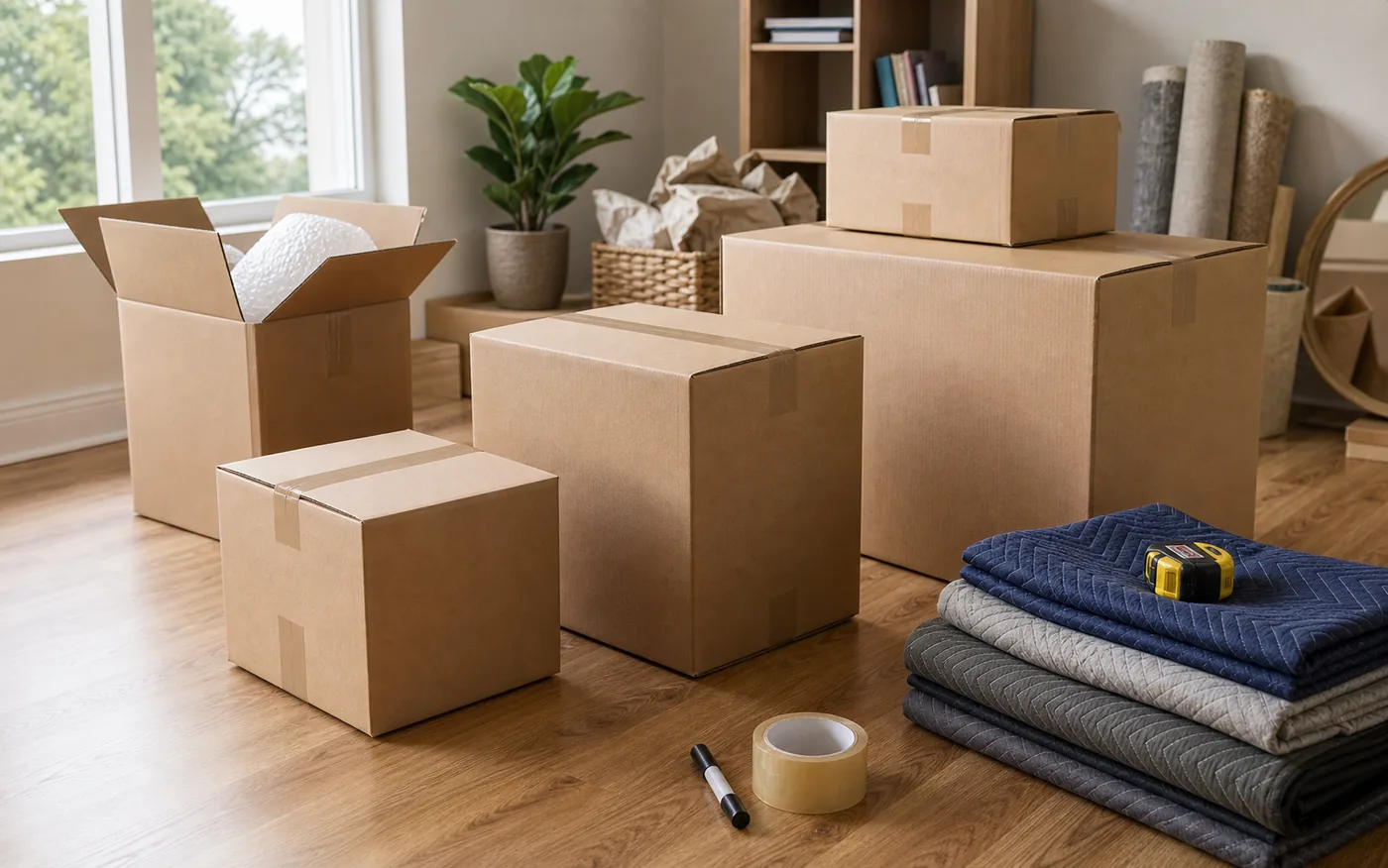
How this moving box calculator works
The calculator starts with rooms and storage areas, then adjusts the box mix for packing density, books, fragile items, and hanging clothes. It separates small, medium, large, dish, and wardrobe boxes because each size is useful for different belongings.
How many moving boxes do I need?
Start with bedrooms, bathrooms, living areas, kitchens, closets, and storage spaces. Then adjust for dense items, fragile items, and wardrobe closets. The result gives a shopping mix of small, medium, large, dish, and wardrobe boxes.
Moving box estimate by home size
Bedroom count is only a starting point, but it helps set expectations before you adjust for closets, books, fragile items, and packing density. Use the calculator above for the actual mix because a sparse two-bedroom home can need fewer boxes than a dense studio.
- Studio apartment: start with small and medium boxes for kitchen, clothes, books, and decor.
- 1-bedroom home: add bedroom, closet, kitchen, and living area boxes before fragile items.
- 2-bedroom home: check closets, books, dishes, linens, and wardrobe boxes separately.
- 3-bedroom home: plan a larger box mix plus more tape, labels, and room-by-room sorting.
- 4-bedroom home: review each room and storage area instead of relying on one quick average.
How many moving boxes for a 1-bedroom apartment?
A 1-bedroom apartment usually needs a mix of small boxes for dense items, medium boxes for general packing, a few large boxes for lightweight bulky items, and dish or wardrobe boxes when needed. Closets and books often change the estimate more than the bedroom count alone.
How many moving boxes for a 2-bedroom home?
A 2-bedroom home often needs a larger medium-box count plus small boxes for books, tools, pantry items, and bathroom supplies. Add dish boxes for fragile kitchen items and wardrobe boxes when hanging clothes should stay on hangers.
Small vs medium vs large moving boxes
Use small boxes for heavy dense items, medium boxes for most household goods, and large boxes for lighter bulky items. Oversized boxes can become too heavy quickly when filled with books, tools, dishes, or pantry items.
Moving box formula
Base boxes = Room mix + closet mix + item adders
Adjusted boxes = Base boxes x packing density
Total boxes = Small + Medium + Large + Dish + Wardrobe
Tape rolls = Total boxes / 15, rounded up
Example calculation
A two-bedroom home with one bathroom, one living area, one kitchen, three closets, some books, average fragile items, and two wardrobe closets estimates about 51 boxes. The mix includes small boxes for dense items, medium boxes for general packing, large boxes for lighter bulky items, dish boxes, and wardrobe boxes.
Common moving box mistakes
- Putting books or tools into oversized boxes.
- Counting bedrooms but forgetting closets, cabinets, garage items, or storage areas.
- Buying boxes without checking moving company weight or labeling rules.
- Forgetting tape, labels, markers, and packing paper.
Moving box calculator FAQ
How many moving boxes for a studio apartment?
Use a studio estimate as a starting point, then adjust for closets, books, kitchen items, fragile items, and packing density. A lightly furnished studio can need far fewer boxes than a dense studio with storage.
How many moving boxes for a 3-bedroom home?
A 3-bedroom home should usually be reviewed room by room. Bedrooms, closets, kitchen items, books, garage or storage areas, and wardrobe needs can change the box mix more than bedroom count alone.
How many tape rolls do I need for moving boxes?
This calculator estimates tape rolls from the total box count as a planning shortcut. Buy based on box count, packing style, tape width, and whether boxes need extra reinforcement.
Should I use large boxes for books?
Large boxes are usually better for lighter bulky items. Books, tools, dishes, and dense pantry items are safer to plan in small boxes so each box stays easier to lift.
How many moving boxes do I need?
Box needs depend on room count, closets, packing density, books, fragile items, and whether hanging clothes need wardrobe boxes. Use this estimate as an early supply list, then adjust for actual belongings.
Why does the calculator separate small, medium, and large boxes?
Small boxes are better for dense items such as books and tools. Medium boxes work for general items, while large boxes should usually be saved for lighter bulky items.
Should I buy extra moving boxes?
A small buffer is useful for last-minute items, awkward belongings, and packing mistakes. Keep receipt and return policy details in mind before buying a large surplus.
Can this replace moving company guidance?
No. Moving company limits for box weight, fragile packing, specialty items, and labeling should be checked before final packing.
Related calculators and guides
Calculation transparency
Method & Sources
This section documents the calculation boundary, arithmetic, rounding, and editable planning presets used by the Moving Box Calculator.
What it calculates
- Produces a planning mix of small, medium, large, dish, and wardrobe boxes from room counts, closets, packing density, books, fragile goods, and hanging-clothes inputs.
- Also estimates tape rolls and labels from the resulting box mix.
What it does not calculate
- It does not inventory individual possessions, measure item volume or weight, size a truck or storage unit, or quote a moving service.
- It does not determine packing requirements for art, electronics, hazardous materials, valuables, oversized items, or carrier-restricted goods.
Formula
- Each box category starts with a room-and-closet weighted preset, adds book or fragile-item allowances where relevant, and multiplies by 0.8, 1.0, or 1.25 for light, average, or heavy packing density.
- Tape rolls = max(1, ceiling(total boxes / 15)); labels = total boxes + 10; wardrobe boxes = ceiling(selected wardrobe closets x 1.25).
Rounding rules
- Every box and supply output rounds up to a whole item. At least one tape roll and one packing-paper bundle are shown when the estimate produces a move plan.
Why the defaults are planning presets
- Room weights, density multipliers, and supply ratios are HomeMeasureKit planning presets, not industry standards. They create an editable starting point because household inventories vary too widely for a room count to be exact.
Sources to check
- Measurement Assumptions & Unit Conversion HomeMeasureKit's shared policy for units, precision, waste factors, package rounding, and estimate limits.
- How to Estimate Moving Boxes Inventory adjustments for books, kitchen goods, storage areas, and fragile items.
- Actual inventory and mover packing rules Primary project sources for item counts, weight limits, specialty containers, and prohibited goods.