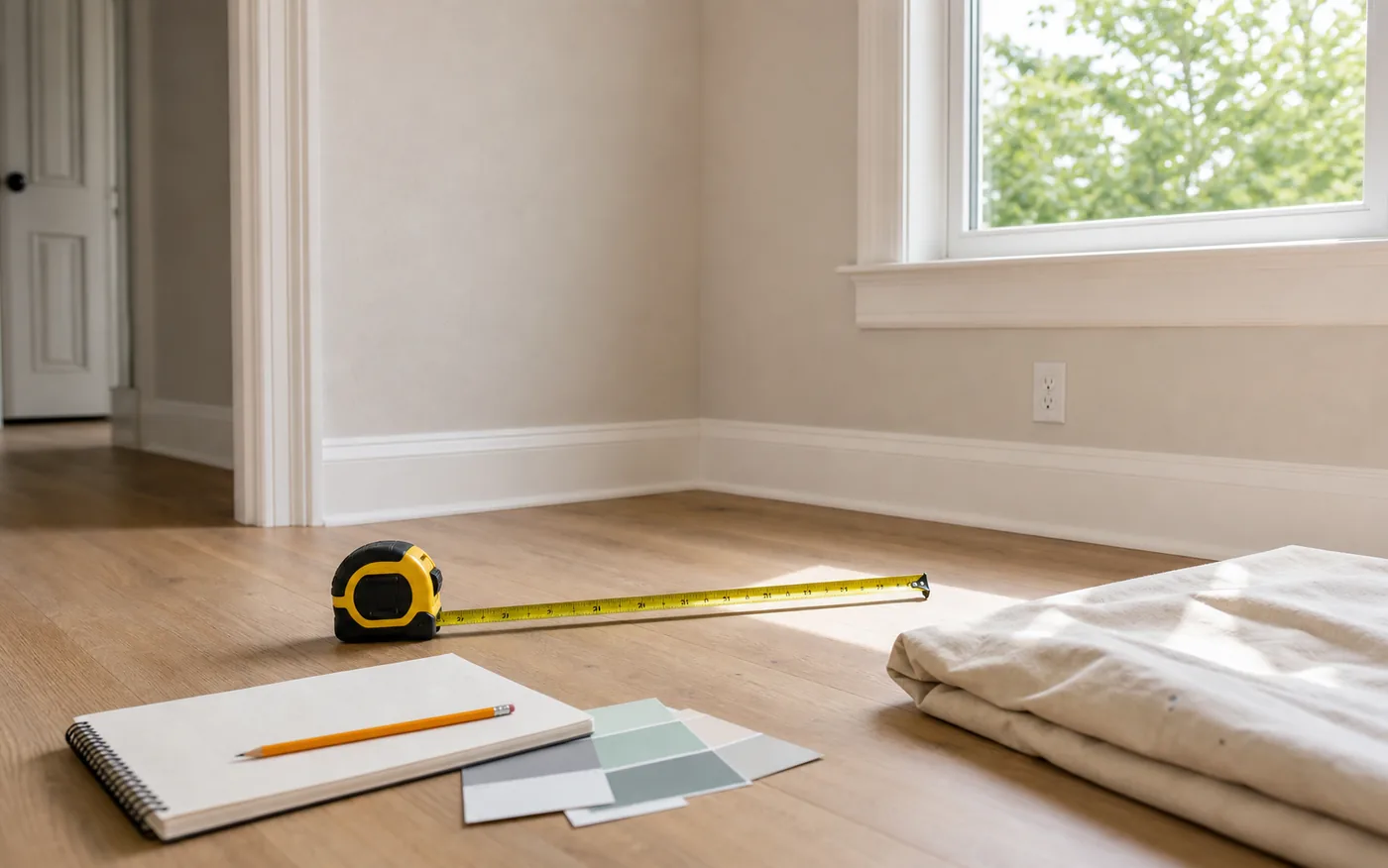
Worked scenario
Example-size comparison
A small bedroom might be around 10 ft by 10 ft, or 100 sq ft. A medium bedroom might be around 12 ft by 12 ft, or 144 sq ft.
Worksheet
Actual-room comparison worksheet
- Start with an example room size only when real measurements are unavailable.
- Measure the actual length and width as soon as possible.
- Use wall height for paint and wallpaper estimates.
- Add closets or alcoves when materials continue into them.
Checklist
Benchmark misuse checks
- Treating example room sizes as standards.
- Using a listing's room size without checking the actual space.
- Ignoring closets and connected areas.
- Using floor area for wall material estimates.
Example sizes
- Small bedroom: 10 ft x 10 ft example.
- Medium bedroom: 12 ft x 12 ft example.
- Living room: 12 ft x 18 ft example.
- Bathroom: 5 ft x 8 ft example.
Why measuring still matters
Furniture layout, closets, alcoves, ceiling height, and irregular walls can make two rooms with similar labels need different material quantities.
Measured data and planning inputs
Room-size scenarios for rough budgeting only
These deliberately simple rectangles are comparison presets, not code minima, market averages, or design recommendations. They help test a budget before a property can be measured and must be replaced with actual dimensions before materials are ordered.
| Scenario label | Planning dimensions | Floor area | Evidence |
|---|---|---|---|
| Compact room | 9 ft x 10 ft | 90 sq ft | Planning preset Illustrative budgeting rectangle; not a standard bedroom or occupancy size. |
| Mid-size room | 12 ft x 14 ft | 168 sq ft | Planning preset Illustrative comparison size; actual room use and local requirements vary. |
| Larger room | 15 ft x 18 ft | 270 sq ft | Planning preset Illustrative large-room scenario, not a design recommendation. |
Do not use these labels to determine occupancy, egress, accessibility, ventilation, or code compliance.
For paint, wallpaper, or wall panels, floor area is insufficient; actual perimeter, height, and openings are required.
Sources and references
- U.S. Census Bureau: Characteristics of New Housing Accessed July 2026. Reports whole-home square footage and bedroom characteristics rather than universal dimensions for named rooms.
- U.S. Census Bureau: Units, Rooms, and Bedrooms Accessed July 2026. Explains how room counts support housing statistics; it does not define a standard room footprint.
Visual measurement worksheet
Three room footprints drawn at a common scale
Compact, mid-size, and larger rectangular footprints are aligned on one baseline so the change in floor area is visible without implying a required room shape.
Contrasting conditions
A harder case: equal floor area with different perimeters
Compare a 10 ft by 16 ft room with an 8 ft by 20 ft room. Both have 160 sq ft of floor area, but their perimeters differ. Assume an 8 ft wall height and ignore openings only for this comparison.
- Room A area: 10 x 16 = 160 sq ft; perimeter: 2 x (10 + 16) = 52 ft.
- Room B area: 8 x 20 = 160 sq ft; perimeter: 2 x (8 + 20) = 56 ft.
- Gross wall area for A: 52 x 8 = 416 sq ft.
- Gross wall area for B: 56 x 8 = 448 sq ft, which is 32 sq ft more despite equal floor area.
Result: The two rooms need the same base floor-area calculation but not the same gross wall-area plan. A floor-area room category therefore cannot reliably predict paint or wallpaper quantity.
Review: This contrast shows why common-size tables are useful only for rough comparisons. Shape, height, and openings become decisive as soon as the project moves from floor materials to walls or window treatments.
Using the scenarios for early budgeting
Use a size scenario to answer a bounded early question, such as whether a flooring option is roughly affordable for 100, 170, or 270 square feet. Do not quietly promote the scenario into a measured project. When access to the room becomes available, replace the single rectangle with named sections and preserve the old scenario only as a budget comparison. A measured 168 sq ft room can still require a different number of boxes from another 168 sq ft room because cuts, connected closets, plank direction, and exact carton coverage differ.
Room names are particularly weak inputs. One person's small bedroom may be another person's office, and an open-plan living area may have no clear rectangular boundary. Define the material boundary instead: where flooring stops, which walls receive paint, where a rug should anchor furniture, or where a curtain rod will extend. This keeps HomeMeasureKit focused on measurable surfaces while leaving occupancy, code, accessibility, and design suitability to the applicable rules and qualified advice.
Before replacing examples with measurements
- Use example sizes only for early planning.
- Measure the actual room length and width before buying materials.
- Add closets, alcoves, and connected spaces when materials continue into them.
- Measure wall height for paint or wallpaper planning.
- Use product coverage values instead of room-size examples for final shopping.
When a room-size scenario is sufficient
Example room sizes are enough only for rough budgeting or comparing projects before actual measurements are available.
When real measurements must replace the preset
Product labels should replace example room sizes before purchasing. Professional help matters when material planning depends on code, structural conditions, or safety-critical work.
Checking a room-size comparison
Use common room sizes only as a planning comparison. They can help you understand whether a project is roughly small, medium, or large, but they should not replace measurements from the actual room.
When you move from examples to a real purchase, write down the actual length, width, wall height, and included spaces. A room label such as bedroom or living room is less important than the measured surfaces.
Before buying materials, run the measured room through the matching calculator and update coverage, box size, tile size, or waste factor from the product label. That final step turns a rough example into a usable shopping estimate.
Continue from a size scenario to measured tools
Last reviewed: July 28, 2026