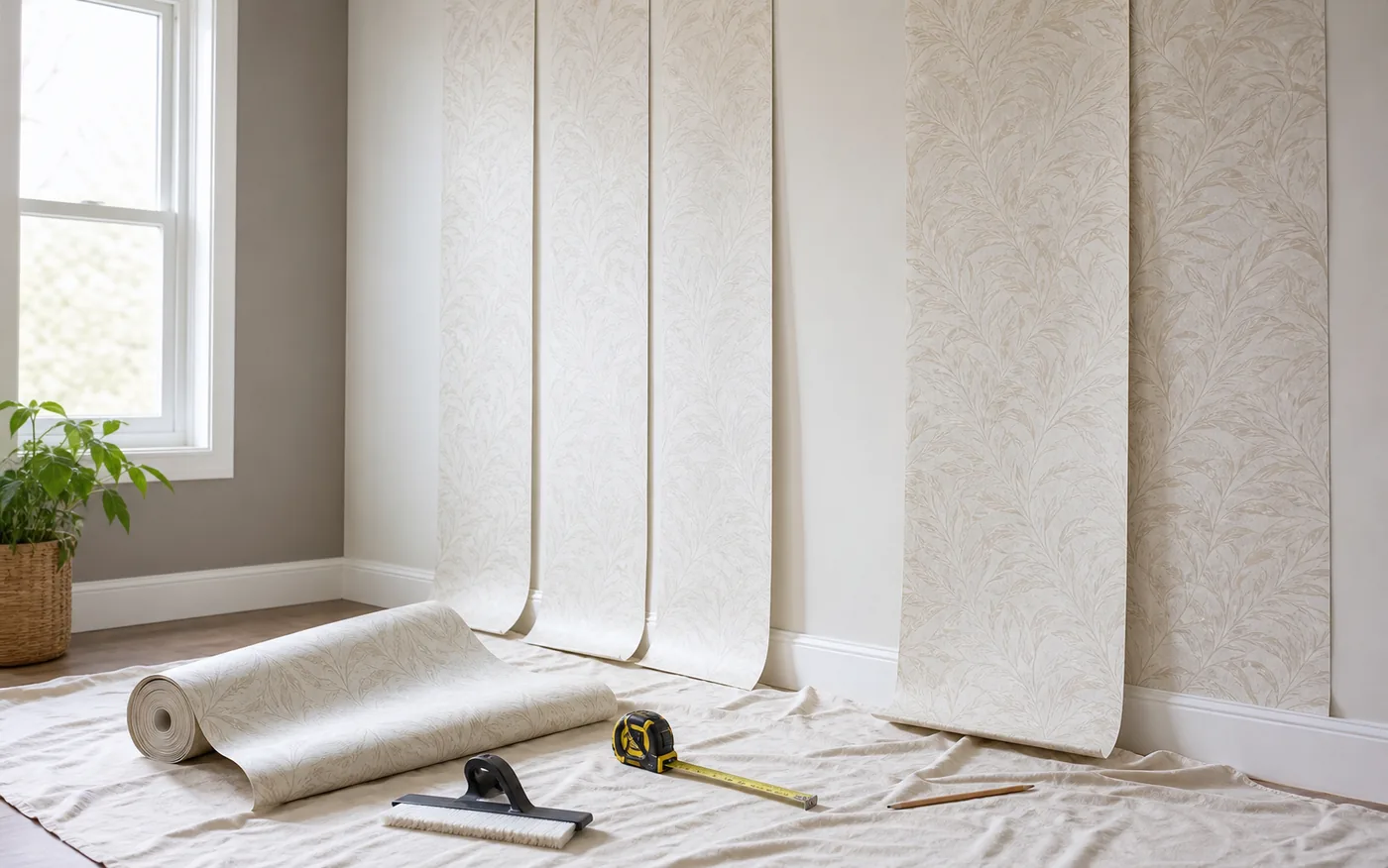
Worksheet
Strip and repeat worksheet
- Measure wall height and wall length.
- Note door and window positions, but do not assume every opening saves a full roll.
- Check roll width, roll length, and pattern repeat.
- Plan extra material for matching and mistakes.
- Keep product instructions close when finalizing the purchase.
Checklist
Roll-order checks
- Using wall area alone for patterned wallpaper.
- Ignoring pattern repeat.
- Subtracting every opening too aggressively.
- Not checking roll dimensions before buying.
Worked scenario
Pattern-repeat roll scenario
A wall might have less square footage than a roll can cover, but a large pattern repeat can still require extra strips to keep the pattern aligned.
Pattern repeat
Pattern repeat is the distance before a wallpaper pattern repeats. Larger repeats can create more offcuts when matching strips.
Doors and windows
Openings may reduce wall area, but they do not always reduce roll count in a simple way because strips still need to align.
Measured data and planning inputs
Published roll dimensions versus usable strip planning
York's Full Sails product page gives a concrete roll and repeat example. Nominal square footage alone does not show how many full-height strips a roll yields, because pattern matching and trimming consume length.
| Published value | Full Sails example | Planning implication | Evidence |
|---|---|---|---|
| Roll width | 20.5 in | Each full strip covers 20.5 in of wall width before trimming | Primary source York Wallcoverings product page Accessed July 2026 |
| Roll length and area | 33 ft; about 56 sq ft | Area is a reference, not the guaranteed matched yield | Primary source York Wallcoverings product page Accessed July 2026 |
| Pattern repeat and match | 20.5 in; straight match | Cut lengths may need to align at repeat boundaries | Primary source York Wallcoverings product page Accessed July 2026 |
Use the current specification for the exact pattern and dye lot. Other wallcoverings can have different widths, lengths, repeats, and match types.
A strip-based check is especially important when wall height is close to the point where one fewer strip fits on a roll.
Visual measurement worksheet
Wallpaper strips aligned to a pattern repeat
Three vertical strips show the same motif moving down the roll, with repeat intervals marked and the next strip advanced until adjacent motifs align.
Contrasting conditions
A harder case: a tall wall with a straight repeat
A feature wall is 13 ft 8 in wide and 9 ft 2 in high. The selected roll is 20.5 in wide by 33 ft long with a 20.5 in straight repeat. The planning strip length includes 4 in for top and bottom trimming before matching to the next repeat.
- Wall width is 164 in. Divide by 20.5 in to get exactly 8 strips before seam and corner review.
- Raw strip length is 110 in wall height + 4 in trim = 114 in.
- Round 114 in up to the next 20.5 in repeat multiple: 6 repeats = 123 in per planned strip.
- A 33 ft roll is 396 in, so 396 / 123 = 3 full matched strips per roll; 8 strips require 3 rolls.
Result: The strip method gives 3 rolls. A nominal area check would compare roughly 123 sq ft of wall with about 56 sq ft per roll and appear to need only 2.2 rolls; both round to 3 here, but the strip method explains the real matched yield.
Review: This example is deliberately near a repeat boundary. A small wall-height or trim change can alter the planned strip length, so the product instructions and installer layout should replace the preset trim value before ordering.
Using roll data with measured wall strips
Wallpaper planning has two constraints: horizontal strip count and vertical roll yield. The wall width controls how many strips are needed; the wall height, trimming, repeat, and match type control how many full strips come from a roll. Doors and windows may create reusable pieces, but relying on those pieces before laying out the pattern can leave unusable remnants. Record each wall width separately and decide where the first full strip starts, especially around a focal point or outside corner.
Product naming can also obscure quantity. A listing may describe a single roll, double roll, bolt, or packaged roll while quoting dimensions for the package. Use dimensions rather than the label alone, and confirm that every roll shares the required lot or batch. The calculator gives an early roll count; it does not decide wall preparation, adhesive, seam placement, reverse hanging, surface compatibility, or whether a specialty material should be installed by a professional.
Before you order wallpaper
- Measure wall height and wall length for each wall section.
- Record doors and windows, but do not rely on openings to reduce roll count exactly.
- Check roll width, roll length, and pattern repeat.
- Plan extra material for pattern matching and trimming.
- Keep the wallpaper product instructions nearby before ordering.
When the wallpaper calculator is sufficient
A calculator can help with wall area and early roll planning, but patterned wallpaper often needs product-specific matching checks.
When pattern and product guidance control the order
Wallpaper labels matter for roll dimensions, pattern repeat, match type, and adhesive instructions. Professional help may matter for damaged walls, moisture problems, or specialty wallcoverings.
Checking a pattern-matched roll estimate
Review wallpaper estimates by wall section rather than only by total wall area. Patterned wallpaper often depends on strip length and matching, so a simple area total can hide the real reason extra rolls are needed.
If the design has a large repeat or a drop match, leave room in the estimate for matching waste. A plain wallpaper and a large-pattern wallpaper can cover the same wall area but require different roll counts.
Before ordering, check the roll dimensions, match type, repeat length, batch or dye lot guidance, and return policy. Those product details matter more as the pattern becomes more complex.
Continue from wall strips to roll planning
Last reviewed: July 28, 2026