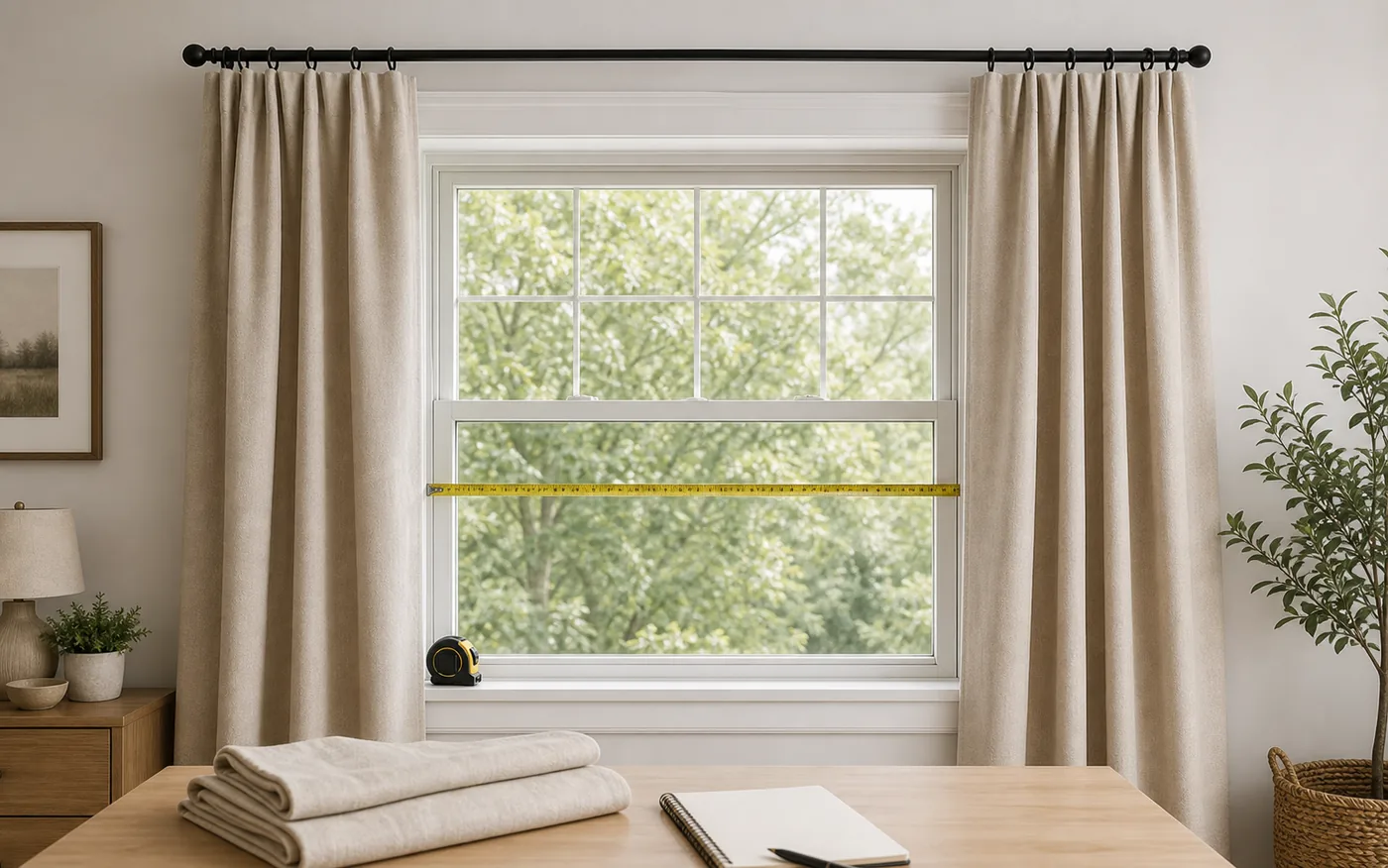
Worksheet
Rod-to-panel worksheet
- Measure the window opening width and height.
- Choose where the curtain rod or track will be mounted.
- Measure the planned finished width from end to end.
- Choose a fullness multiplier based on the fabric look you want.
- Measure the finished length from mount position to sill, apron, floor, or puddle point.
- Compare the result with actual panel dimensions before buying.
Checklist
Mounting and clearance checks
- Buying panels based only on glass width.
- Forgetting rod extension beyond the window frame.
- Confusing panel width with total pair width.
- Choosing length before deciding where the rod will sit.
Worked scenario
Fullness multiplier scenario
A 60 in wide window might use a rod that extends to 72 in. With 2x fullness, the curtain panels together need about 144 in of fabric width before checking product sizes.
Fullness
Fullness is the extra fabric that creates folds. A flat panel, casual gather, and fuller drape can all start with the same window but need different total panel width.
Length style
Curtains can stop near the sill, below the sill, at the floor, or slightly beyond the floor. The right measurement depends on the mount position and the look you want.
Measured data and planning inputs
Published curtain width and fullness example
IKEA's STOCKHOLM 2025 curtain pair publishes a 57 in by 98 in panel size and illustrates three fullness levels. The example shows why finished rod width must be multiplied before it is divided by the width of one panel.
| Fullness example | Fabric width for a 72 in rod | 57 in panels before rounding | Evidence |
|---|---|---|---|
| 1.5x fullness | 108 in | 1.89 -> 2 panels | Primary source IKEA STOCKHOLM 2025 curtain product page Accessed July 2026 |
| 2x fullness | 144 in | 2.53 -> 3 panels | Primary source IKEA STOCKHOLM 2025 curtain product page Accessed July 2026 |
| 2.5x fullness | 180 in | 3.16 -> 4 panels | Primary source IKEA STOCKHOLM 2025 curtain product page Accessed July 2026 |
The arithmetic uses the product's published 57 in width per panel. Confirm whether another listing reports one panel or a pair.
Header construction, overlap, returns, stacking, hemming, and fabric behavior can change the usable finished width.
Visual measurement worksheet
Curtain flat width gathered across a finished rod
A 72-inch rod is shown above three fabric bands representing 1.5, 2, and 2.5 times fullness, with the extra width compressed into progressively deeper folds.
Contrasting conditions
A harder case: an outside-mount window with side returns
A 60 in window will use a rod extending 8 in beyond the opening on both sides, creating a 76 in finished span. The treatment uses 2x fullness and needs an additional 4 in total to return toward the wall. Each selected panel is listed as 52 in wide.
- Finished rod span: 60 + 8 + 8 = 76 in.
- Full fabric width at 2x: 76 x 2 = 152 in.
- Add the two side returns: 152 + 4 = 156 in total flat width.
- Panel count: 156 / 52 = exactly 3 panels, then verify whether the product is sold singly or only in pairs.
Result: The width calculation needs 3 panels, but packaging may require purchasing 4 if the product is sold only as pairs. Length remains a separate decision based on actual rod height, heading, hem, floor clearance, and product dimensions.
Review: This case contrasts with a window-width-only estimate because rod extension and returns increase the finished span. It also separates the mathematical panel count from the purchasable package count.
Applying finished span and fullness together
Measure the installed hardware position rather than assuming it matches the window opening. Rod width can include stack-back space that exposes more glass, while brackets and finials may limit usable travel. For length, measure from the point where the chosen header hangs on the rod or track to the intended sill, apron, floor, or puddle endpoint. Check the manufacturer's stated dimensions and care information before altering a panel because washing, hemming method, and header construction can affect finished length.
Fullness is an appearance and function choice, not a safety or structural calculation. Sheer fabric, heavy lined panels, eyelets, pleats, and wave tracks can use width differently. Hardware capacity, mounting substrate, child-safety requirements, heaters, vents, and door clearance are outside the panel-width arithmetic. For heavy or unusually high treatments, verify anchors, brackets, and installation with product documentation or qualified help instead of relying on window measurements alone.
Before you buy curtain panels
- Measure the window opening width and height.
- Mark the planned rod or track position before choosing panel length.
- Measure the finished width from rod end to rod end.
- Choose a fullness multiplier before comparing product sizes.
- Check whether the listed width is per panel or per pair.
When the curtain calculator is sufficient
A measurement guide is enough for early curtain shopping when rod placement, finished width, length style, and fullness are clear.
When hardware and product dimensions take priority
Product guidance matters for panel width, header style, rod pocket size, hardware limits, and care instructions. Professional help may matter for heavy treatments, difficult mounting surfaces, or child-safety hardware.
Checking panel width and package count
Review finished width, fullness, and panel count together. If a product lists panel width individually, calculate the combined width before deciding whether the curtain will look full enough.
Check the finished length against rod height, floor clearance, sill position, and heating or vent locations. Small changes in mounting height can change which standard panel length fits best.
Before buying, compare the guide estimate with product dimensions, header style, hardware requirements, and return policy. Curtains are often easier to adjust before hardware is installed.
Continue from window measurements to panels
Last reviewed: July 28, 2026